For more than a decade, IÖN has been creating music from behind the scenes.
As part of the producer duo GroovyRoom, he’s helped shape some of Korea’s hip-hop and K-pop landscape, often working to bring someone else’s vision to life. But eventually, he wanted a space to tell his own story. That realization became IÖN, a project that gives him the freedom to explore dance music, DJing, and a side of his creativity that had been waiting to step into the spotlight.
Now, that story is continuing to unfold through XEÖUL, a project deeply connected to the city where IÖN has spent years making music and experiencing its ever-changing nightlife. Rather than getting caught up in the boundaries of genre, he’s more interested in what music can make people feel—and ultimately, whether it makes them move.
With XEÖUL, IÖN is exploring what happens when those ideas meet the people, places, and energy that make Seoul what it is, creating something that feels less like a definition and more like a snapshot of the city in motion.
For Sweety High, IÖN opened up about stepping into his own story, finding his creative identity outside of his work as a producer, and bringing XEÖUL to life. As IÖN continues carving out his own space, there’s plenty more to discover about the artist behind the sound. Read our full interview with IÖN below.

(Image courtesy of ARC Company)
Sweety High: For readers who may be discovering IÖN for the first time, how would you introduce yourself and your work to someone who’s just discovering you?
IÖN: Hello, I’m IÖN. I make dance music and DJ in Seoul. Genre-wise, I lean toward house and techno, but I don’t really like defining things by genres. To me, what matters much more is: Does this music make people move?
For over 10 years, I’ve been active as part of the producer duo GroovyRoom, mainly working on hip-hop and K-pop in Korea. But being a producer ultimately means stepping back to make someone else shine. One day, it hit me clearly: Ah, I might never have a moment where I get to tell my own story.
That’s why I started IÖN. The name comes from “ion”, the charged particle. I’m a bit of a science nerd.
Also read about: WHIB on Beginning a Sweet New Chapter With CHERRY PIE
SH: You’ve worked across so many different sounds. When you’re making music as IÖN, what makes you hear a track and think, “Yeah, this belongs here”?
IÖN: Usually, it happens when I’m digging for tracks to play in my DJ sets and get hooked on a song, or when I play a track live and the crowd’s reaction completely blows up. I used to listen and create with streaming platforms in mind; now the most important question is whether it’s something I can play in my DJ sets.
When making XEÖUL, I tried to listen closely to the DJs I collaborated with. I asked them questions like: Which tracks get the best response when you play them? What’s your signature secret weapon? What message do you want to convey? Then I reflected those answers into the music. I used to make music that was good to listen to, now I try to make music that is good to experience. I think that’s the biggest difference.
SH: You’ve described the project through IÖN as a different way of expressing yourself. What does IÖN allow you to explore creatively?
IÖN: When working as a producer for other artists, my job ended as soon as I handed over the track. I didn’t get to decide what image the song took on or what kind of stage it was performed on. With IÖN, I get to do all of that. For this album, I even handled the mixing and mastering myself.
The biggest difference between what I used to make and dance music comes down to purpose and function. In pop music, vocals are usually the main character, but music played by a DJ needs to deliver pure energy entirely on its own. Because of that, I spend far more time researching sound design, focusing heavily on how to convey energy through raw sound. After all, it only becomes real dance music when it actually gets people moving.
SH: A lot of the track titles on XEÖUL feel like snapshots of places, people, or moments rather than typical song titles. How much of the project came from things you’ve actually experienced around Seoul?
IÖN: Almost all of it. The locations in the track titles are places I actually hang out at, and most of the featured DJs are people who actively play in those areas. Throughout the creative process, I talked extensively with the DJs about our shared experiences. We spent a lot of time reflecting on the unique characteristics of Seoul’s clubs, what we consider to be the true “Seoul sound,” and the overall message we wanted the music to carry.
With this album, I really wanted to focus on localizing the vibe. I tried my best to capture the unique culture and phenomena of Seoul, the things I’ve observed and felt while going out and experiencing the city firsthand, and mirror them in the tracks.
SH: If someone had never been to Seoul before and you could play them just one song from XEÖUL to give them a feeling for the city, which track would you choose and why?
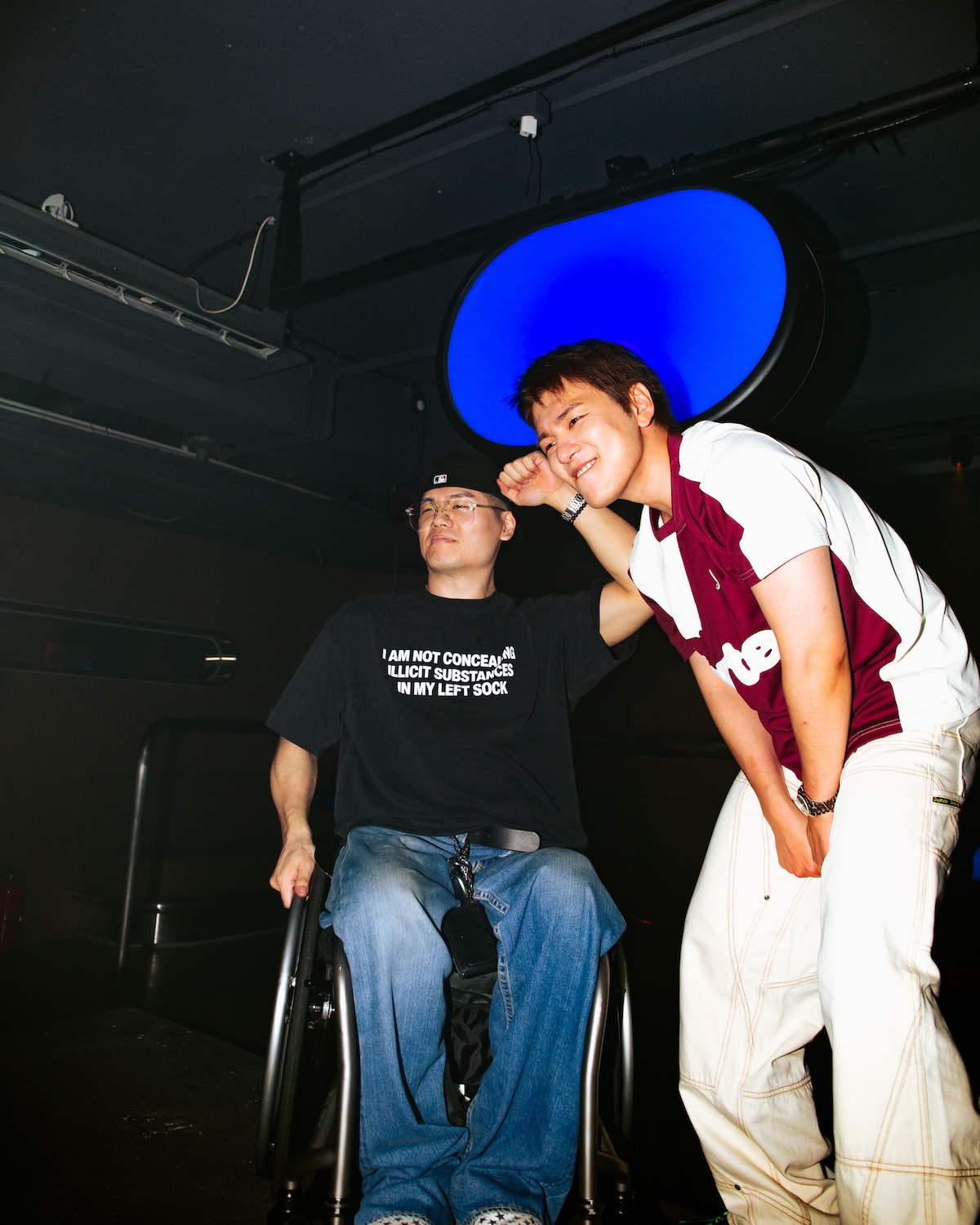
IÖN: “Haebang Bounce.” It’s a track I made with BRLLNT, who really represents the Seoul club sound.
BRLLNT is the person who essentially created the edit (remix) culture among Seoul DJs. Seoul is unique because hip-hop and dance music are heavily blended together, and BRLLNT translates that fusion brilliantly, to the point where a whole wave of DJs followed his style.
(Image courtesy of ARC Company)
When BRLLNT first sent over the initial sketch file for this track, the working title was “ghetto tech.” But as we developed it, it moved away from traditional ghetto tech and evolved into a very distinct mood. I think that kind of hybrid fusion itself is what defines the spirit of Seoul, and specifically, the vibe of Itaewon.
SH: You’ve obviously spent a lot of time around Seoul’s music scene. What’s something about it that you think people outside Korea don’t really understand?
IÖN: Seoul doesn’t actually have a single “Seoul genre.” I spent a long time contemplating what genre represents Seoul, but I couldn’t find an answer. Instead, creators here excel at absorbing new trends lightning-fast and fusing different elements together. I think that sheer speed and density of absorption is the sensibility of Seoul.
Also, because hip-hop was massive in Seoul during the 2010s when I started making music, those traces still remain in today’s dance music. It’s not just a direct copy of European techno; it’s a sound that passed through the lens of hip-hop club culture.
During the 2010s, Korea experienced a hip-hop golden age driven by the show Show Me the Money. Traditional EDM clubs disappeared, and hip-hop clubs and lounges exploded in popularity.
When I started DJing heavily in clubs after COVID in 2022, I mostly played hip-hop tracks. But back then, the music embraced by most hip-hop clubs was ultimately “songs people already knew.” If I played a hip-hop track I thought was super cool, the response was lukewarm, and if I mixed in dance music, people felt unfamiliar with it. So I started looking for remixes of familiar songs, or dance music that felt closer to hip-hop. That’s why genres like U.K. Garage, Breakbeat and Baile Funk were adopted as alternatives; they felt natural to the senses of people coming out to hip-hop clubs.
That was the starting point, and now dance music has become the dominant sound in Seoul’s club venues. Dance music was born to make people dance, so it naturally fits people who come out looking for a good time.
From then on, I stopped categorizing music by genre and started organizing it by purpose: not whether it’s house or techno, but is this music meant for dancing?
What’s less visible from the outside is that Seoul’s scenes operate completely separately depending on the neighborhood. Gangnam, Itaewon, and Hongdae have totally different atmospheres, and DJs often don’t even know each other’s names across those boundaries. Bridging those disconnections is a challenge we need to solve moving forward.
SH: There are nine tracks and a lot of different collaborators on XEÖUL. What was it like bringing all of those different sounds together?
IÖN: I set one single anchor rule: “Can this be played in any venue in Seoul?” I established this standard because of my previous album, CÖURAGE. It’s an album I still love deeply, but it was much more about expressing my inner message and exploring the styles I wanted to do personally. After releasing it, I felt a slight regret: because it leaned pop-heavy with long melodic sections, it lacked the raw energy needed for clubs or festivals.
So for XEÖUL, I met with the people first. I told artists like rom and BAAWLA, “You guys are the sound of Seoul clubs right now; I want you to anchor this album.” Even though the genres range from ghetto tech to U.K. Garage and Baile Funk, as long as a track passed that single standard, everything flowed together naturally within the album.
Also read about: Tiger Lewis Brought His Debut EP to Life at the Moroccan Lounge
SH: When you’re making music that’s so focused on energy and movement, what do you want people to feel before they even realize they’re dancing?
IÖN: A sense of release. I want their tension to melt away before they even realize their body is moving.
The reason people hesitate to dance in clubs is self-consciousness, worrying about how others see them or questioning whether it’s okay to let loose. If that anxiety is there, the body will never move because the mind is constantly self-censoring. That’s why I used to go out to clubs or festivals alone a lot. If you’re with people you know, thoughts creep in like: Are they having fun? Do I look weird dancing like this?
So I think letting go of worries has to come first. Once that happens, the body takes care of itself. Before a listener realizes, “Oh, wait, I’m dancing,” they need to have already laid something down internally.

(Image courtesy of ARC Company)
SH: When you’re making a track like this, do you ever make something specifically thinking, “I want people to lose it when this comes on”?
IÖN: Absolutely! Especially when making dance music, designing the flow of energy is the single most important thing. I decide where that peak moment needs to hit first, and then build everything else around it.
However, you never truly know if it’s going to hit while sitting in the studio. That’s how it differs from music meant purely for streaming; you have to play it live in a real environment to find out. A track that sounded somewhat plain in the studio can turn into an absolute essential track that blows the roof off live, while a track I was sure would explode might feel over-the-top and break the crowd’s immersion instead.
SH: You’ve been doing this for a while now, what feels more important to you today than it did when you first started?
IÖN: Before starting IÖN, I was just running aimlessly without even knowing my own taste. I was always chasing “correct answers” and caring way too much about what others thought. Because my music had the underlying motive of needing to be successful, I lost the ability to love it purely.
When I made music purely out of love, I could work all night and never feel tired at all. I wanted to find that feeling again, and now when I work as IÖN, I feel that exact same way. I can sit there all day, and because it’s so fun, I just keep going. Also, I no longer try to convince everyone. If there’s something I genuinely love, there is bound to be someone out there who loves it too.
Also read about: Dabin Is Figuring It Out as He Goes—and Letting the Music Tell the Story
SH: You’ve built a career in one lane with GroovyRoom, then created IÖN as something completely different. What would you tell someone who’s scared to step outside of the thing people already know them for?
IÖN: I wasn’t good at it from the start either. I first learned to DJ around 2018, and my very first stage ended up being World DJ Festival. I went up without even knowing how to operate the equipment properly, and I made tons of mistakes.
Looking back, I was a poser then. I didn’t step in because I genuinely loved the culture; I just tried it because GroovyRoom was famous and getting festival slots was easy. Naturally, it didn’t work out.
During COVID, I felt really helpless, but Hwimin casually tossed out a comment: “Gyujeong, why don’t you try doing something too?” That triggered me. What came back to me then was how much I love electronic music and how much fun I had when DJing. Even when I messed up, the catharsis was huge. So I decided to do it right this time and started again.
Even if you strive to succeed, art doesn’t always go as planned. There are no definitive answers. In that case, it’s much better to spend your time relentlessly doing what you truly love. If you’re hesitant about stepping into a new lane right now, listen closely to your inner voice and ask if it’s something you genuinely love. If you love it, take the leap and just do it.
Staying only where you’re comfortable means you eventually just become average. And as AI advances, average things will be what AI creates best. Humans need to run in directions that break away from the average; that’s the only approach unique to us. Stepping out of your comfort zone is terrifying, but once you just throw yourself into it, it’s much better than you think and actually feels liberating. Really.
(Image courtesy of ARC Company)
SH: When you think about the person who first started making music, what do you think would surprise them most about where you are now?
IÖN: I think they’d be most surprised by the simple fact that I’m releasing these kinds of tracks under my own name. When I was young, I always thought my job was strictly to write songs for other people. I’m also constantly chasing new challenges. Leaving an established position to start over from scratch isn’t an easy choice. Taking that step courageously is something my younger self would feel quite proud of.
Also read about: Splayit Talks SPLAY: CHAPTER 01, Their Debut and the Meaning of Youth
SH: As you look ahead, what are you chasing next, both creatively and personally?
IÖN: I’m not trying to leave behind grandiose records or achievements. Think about what a PhD degree is: picture a massive circle representing all human knowledge. A PhD is granted to someone who makes a tiny, microscopic bump on the edge of that circle, expanding human knowledge by just a fraction. I find that metaphor deeply compelling, and I see it as the best way a human can contribute.
So rather than copying a style someone else does well to achieve quick success, I want to pave uncharted ground and leave my own tiny bump, no matter how small my influence might be. Moving forward, I want to continue presenting new things, however modest, within pop culture and art.
People carry the music and culture they passionately fell in love with during their teens and mid-twenties for the rest of their lives. So if I create enough of “Hey, look how great this is!” for the growing generation right now, in just a few years, those kids will become the generation shaping the culture. I’m betting on that turning point rather than short-term reactions. If I can share experiences, I personally loved with even a few more people; that’s more than enough for me, whether that’s 10 people or 10,000.
Listen to XEÖUL in full here:
For more from the artists who inspire us, click HERE to read our recent interview with off the menu.