Los Angeles has an incredible jazz music history that goes back a century, and in 2026, it’s being honored with the first-ever LA Jazz Festival.
This a 17-day experience all across Los Angeles kicks off on Aug. 7, featuring free Jazz in the Park shows across Los Angeles city parks, a late-night Jazz After Dark series and a Caribbean Street Carnival before ending in a two-night Jazz on the Beach event on Aug. 22 and 23 featuring John Legend, Janelle Monáe, Parliament Funkadelic Featuring George Clinton, Original Koffee and so many more. The aim isn’t just to be a musical event, but a cultural landmark, and it’s positioned to be the third-biggest international jazz festival in the world.
Ahead of this first LA Jazz Festival, we got the chance to hop on a Zoom call with its founder and creator, Martin Ludlow, who told us all about what to expect and why jazz is such an integral part of Los Angeles culture. Read our full interview below.
Sweety High: Tell us about your relationship with jazz music, and with L.A. and how the LA Jazz Festival came to be.
Martin Ludlow: I’m originally from Ohio. I grew up in a small liberal arts college town called Oberlin, and it’s very famous for two things. One, it’s got one of the top three music conservatories in the world. If you’re an undergrad or a grad student and you want to major in music and become a director of a philharmonic or be a first chair cellist with a national symphony, you want to graduate from Juilliard, Berkeley or Oberlin.
Oberlin is also known because it was one of the last stops on the Underground Railroad. In front of the music conservatory is a monument that pays tribute to the tens of thousands, if not hundreds of thousands, of enslaved human beings that made their way to Canada by coming up through Oberlin. During the day, they would sleep in the basements of many of the homes that are still there to this day. At night time, they had a one-night journey to Lake Erie, and at Lake Erie they could catch a boat to Canada. For a lot of young people growing up in Oberlin, such as I did, it left an indelible mark.
Jazz was created in Congo Square, New Orleans, which really was at the beginning of the Underground Railroad. Tens of thousands of enslaved human beings who were part of that narrative were able to get through Jim Crow and through slavery through the little town I grew up in.
I started playing trumpet when I was in elementary school, went on to play drums by middle school and started teaching myself piano in high school. By the time I was leaving Oberlin as a community to go to Ohio State, I was already a low-level touring musician with a little garage band. I was first chair trumpet in my jazz ensemble in high school, first chair trumpet for our orchestra. I was really getting into the Duke Ellingtons and the Jelly Roll Mortons on the jazz side, but also the Bachs and Beethovens on the classical side. It was an early indoctrination—let alone that my mom and dad were listening to Billie Holiday and all that on the record player.
I came to California to pursue football, but also to continue the work that I was doing around building big crowds through music. I learned how to do club promotions and to get people to come out and see our band perform. That ended up turning into a party vibe. I’m going to totally age myself by saying about that time, DJing was really becoming a thing. I fell in love with one of the biggest instruments I ever mastered, which was two turntables and a mixer, and started building even bigger events through mixing and DJing. That led to a career in building big crowds for different moments.
But the biggest moment was when my mom and dad said they were worried about where I was headed in terms of DJing instead of pursuing my degree in music. They asked me if I would start considering helping Reverend Jesse Jackson to build crowds as he was running for president. So I did. I started doing work all over the country. Eventually, that brought me to L.A., and I continued working for people running for president. I was always trying to pick progressive candidate, to get behind them and help build the energy and the hype. That took me into 30-year career of building big events, building big crowds and trying to blend music with social justice.
I brought it all together when I didn’t love what I was seeing in the world of jazz through the lens of one big jazz festival here in L.A. There are a lot of really great jazz festivals, and I knew about the 100-year legacy of jazz in L.A. through Central Avenue and all of those late-night supper clubs, but L.A.’s statement about jazz was this festival taking place at the Hollywood Bowl. I just thought it was so constrained, locked into those 18,000 seats. It’s a weird brand for the celebration of jazz, particularly given that the human rights narrative that’s tied to it.
So I started thinking about what would it take to build something on the scale of a New Orleans Jazz Festival, Montreal, Montreux—which is happening this weekend in Montreux—and that the second largest city in America with the largest media market in the world really deserves to have a world-class, large-scale, multiple-week jazz festival that’s bringing jazz and music and culture to all parts of L.A. and really lifts up its 100-year history of jazz. That’s when it all came together for me.
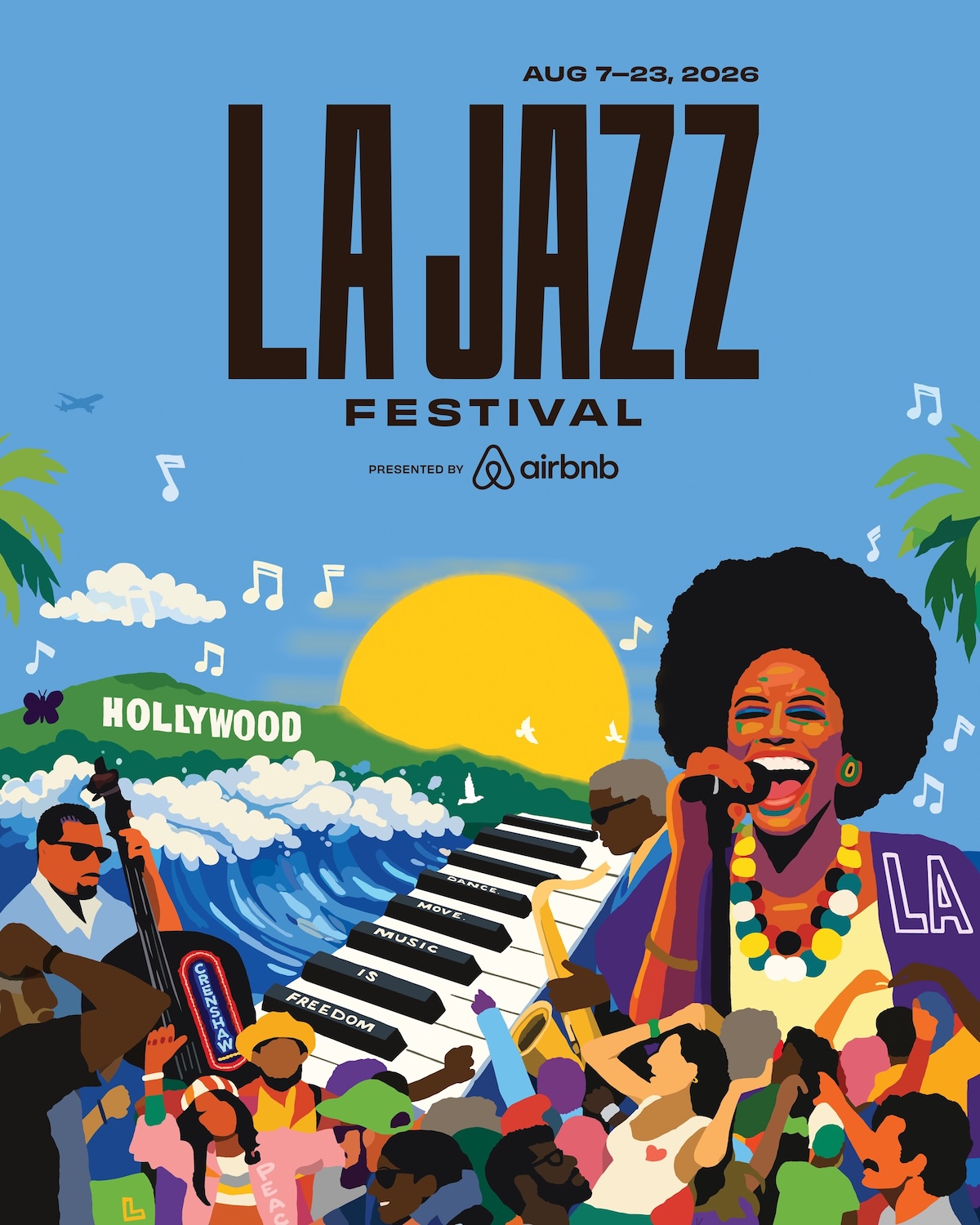
(Image courtesy of the LA Jazz Festival)
SH: The festival takes place all over Los Angeles over the course of 17 days. Can you break down the different aspects of the LA Jazz Festival?
ML: We start with opening night in Leimert Park. We have an incredible lineup from a community-based youth band—Fernando Pullum does a great job with young kids in the community. We then go to the legendary Pete Escovedo. From there, we go to Chief Adjuah, a legendary award-winning trumpeter. From there to Kenyon Dixon, and then to Lalah Hathaway. It’s going to be a magical night for the community.
The next day, we dive into Jazz in the Park. That’ll be 16 shows all over Southern California from all the way out in the Inland Empire—Moreno Valley—to 14 shows in the city of L.A., one in Inglewood, and then another in the L.A. County section of Watts. We’re looking to see thousands of community people come out for free shows. We’ll have multiple artists, really great cultural opportunities.
Then later that night we launch Jazz After Dark. This year, we’re going to feature multiple artists in 20 community-based restaurants and community venues. These will be late night shows from 10 p.m. to 1 a.m—though some may actually start a little bit earlier, 8 or 9.
Jazz in the Park is about making sure that every working Californian and Angelino can literally just go to the park, pull in and not have to worry about all the things that you get sometimes at big events. They can bring their lawn chair and enjoy a day in the park listening to great jazz, eating good food. At great, large-scale jazz festivals like Detroit Jazz Festival, which at one point got three-quarters of a million people to come out, what you see is everyday working people coming out, taking part and enjoying a day in the community. I love what they’ve done with that.
The after-hours events are more about what you experience in Paris, in London, in New York, even New Orleans—the cities that don’t sleep. You can go to New Orleans and go to one of the late night clubs and enjoy shows until the wee hours of the morning. What we want to do with Jazz After Dark is bring that kind of experience to L.A. and feature not only legendary jazz artists, but also local community garage bands, like I was when I was coming up, and giving them an opportunity.
In the second week, we have what are called Coastal Cultural Tours where we’re going to give people an opportunity to get on a charter bus and ride along the locations of the L.A. coastline that tell the narrative of racial coastal pushout. That’s important to the narrative of the festival for a few reasons.
When you look back over the century of jazz in L.A, really the Ellis Island or the flashpoint of that story begins with Creole musicians coming out along the Union Pacific Railroad from New Orleans to play Hollywood scores in L.A. That was an opportunity to both get away from Jim Crow racism at its height in the South, but also to experience an upper working class career that could change their family’s life. They came out here and played in the orchestras behind the Hollywood conductors for those 1920s, 1930 films that are now legendary. They were changing the face of Hollywood, making the movies pop on a whole ‘nother scale. They would come home to South L.A., go to a dinner club and would play there at night. If on the weekends, they wanted to go enjoy the L.A. coastline, the racism really hit hard.
They were not allowed to go and enjoy any place on the beach. They were forced to go to certain sections. One section in particular was called The Inkwell—and yes, it got its name because that’s where Black and brown families were forced to go unless they wanted to be completely harassed or beaten up, to and including local law enforcement. Over time, The Inkwell went from a pejorative to a term of endearment. You can talk to many folks to this day who are in their 70s and 80s and they’ll tell you they remember taking their family to The Inkwell in Santa Monica.
We want to remind people that that is a real history. It goes all the way to Bruce’s Beach, which now is a world-renowned story that the public is becoming more aware of. A Black family by the name of Bruce owned a significant piece of land right on the water. They wanted to make a safe resort for families that were using the Green Book. Travelers could make their way to the west coast, get to Bruce’s Beach and actually enjoy the beautiful coastline like their white counterparts. That family was terrorized and firebombed out of the property by the founding fathers of Manhattan Beach. The city was founded on the backs of the Bruce family and really lost that. There’s a film that we think is coming out this summer that is not only going to highlight Bruce’s Beach, but we’ve been told that they’re documenting over a hundred hundred other stories like it all over America’s coastlines.
We felt like it was really important to tie that narrative into this evolution of jazz, because at its heart and soul, it really is a a genre that was born through both the challenges, the trials and tribulations, but also the joy and fight for freedom that predominantly African American and Caribbean Creole musicians and their families created. We felt the only way to be true to the full narrative is to not just have a final conclusive weekend on Dockweiler Beach and celebrate that moment that we could all be there, but be very intentional about reminding the public about how we got here and never forget that.
We’re also going to have a full day of a conference called the State of Jazz Conference, where we’re going to talk about these issues and how we lift up the genre, how we get more young people involved, how we support more jazz promoters, how we help inspire jazz musicians to learn how to handle business affairs for their craft. Then we will have a Caribbean Street Carnival that night in Venice. We’re going to have four stages—a Cuba stage, a Latin jazz stage, an Afrobeat stage and a New Orleans stage. The New Orleans stage is going to be sponsored by some really great organizations for the arts in New Orleans who really want to see this marriage between the L.A. Jazz Festival and New Orleans come to life. We’re very excited. We expect to see tens of thousands of people for the Caribbean Street Carnival. It’ll have 20 phenomenal musicians from all over the world, ahead of our final two days on Dockweiler Beach.
That 17-day rainbow starts on that opening night and ends on a very dynamic two days featuring thelegendary Janelle Monet, John Legend, and so many other great artists—23 nations represented through the festival and over 160 artists. They range from every imaginable type of jazz that you could think of.
SH: You mentioned John Legend and Janelle Monet, who are both huge mainstream artists with massive crossover appeal. What does it mean to you to have their involvement for this inaugural event?
ML: When I first started working putting this together, one of the first artists that I talked to and had a really incredible conversation with was the legendary Wynton Marsalis. I’ve always been a major fan of Winton. His early classical albums were some of the first albums that shaped my dream of what I might become as a trumpeter one day. I never got there, for sure. But Wynton said to me, listen, I understand fully what you’re pulling off, and to make this work, you’re going to need to bring in very significant artists who have that crossover appeal to be able to drive the finances it’s going to take to put this together and to drive—given how many tickets you’re offering for free—the cost of those paid tickets. Make sure that the artists that you choose are those artists that really have embraced the etymology of jazz and what jazz has done to global music. No two artists speak more to that.
And I don’t even need to stop at those two. I could also add in Charlie Wilson. I could add in Raphael Saadiq. When you listen to some of Raphael’s music and close your eyes, you actually feel yourself right there on Bourbon Street in New Orleans. It’s some of the most incredible acoustic jazz. Original Koffee is one of the top Jamaican female artists potentially of all time. She has so many different beats that are embedded in the Afrobeat, pre-colonized African drumming tradition. It’s just crazy to listen to some of the music that she puts together.
I had this incredible moment with James Fauntleroy and Larrance Dopson, the legendary producers behind 1500 or Nothin’. 1500 or Nothin’, in my opinion, is probably pound for pound one of the greatest hip-hop and R&B production duos of all time, working behind Jay-Z, Beyoncé, Riahnna, Justin Timberlake. They joined us for a seminar where we brought John Clayton, who I refer to as the Dean of Jazz on the West Coast, one of the all-time great upright bassists, and the last living member of the Count Basie Orchestra. We had Irvin Mayfield, Grammy Award-winning acoustic trumpeter from New Orleans, trained by Wynton Marsalis. We put them all together on a stage and had them talk to the audience, and the one thing they all had in common is how they feed off of each other.
At the heart of it are those early rhythms and beats that the Duke Ellingtons, the Count Basies, the Jelly Roll Mortons of the world have created, and it really has sustained music on a global scale that, quite frankly, doesn’t always get its due much in the musicality, in the syncopations, in the rhythms. If you go bar by bar, measure by measure, and you look at some of those early jazz tracks, you’ll see it reflected by hip-hop artists. I think it was Jay-Z talking about Rakim, and he said, if you listen to Rakim breaking off those bars, you’re hearing him imitate the trumpet. That, to me, is just fascinating. I love seeing that energy between hip hop, R&B and jazz.
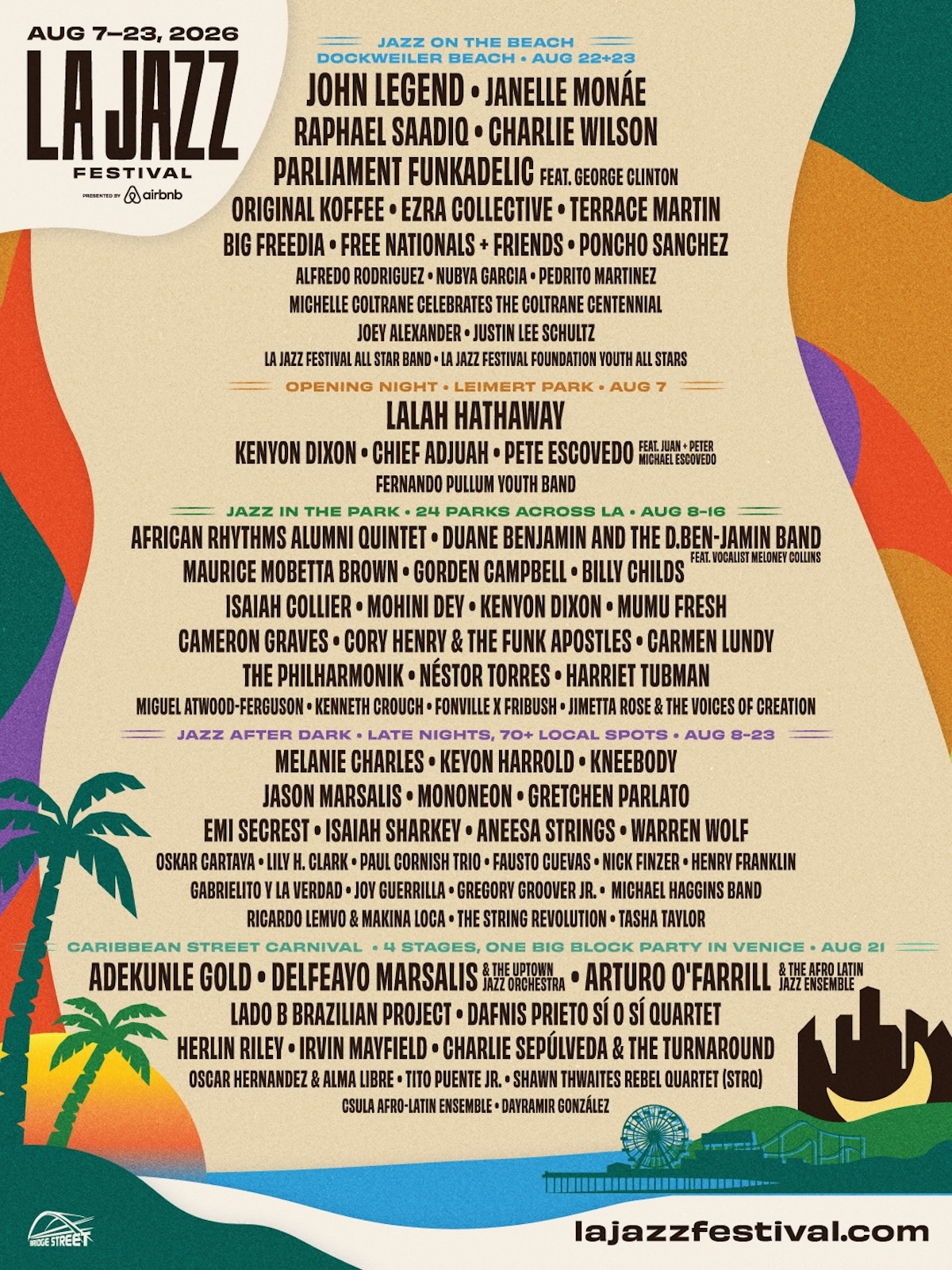
(Image courtesy of the LA Jazz Festival)
SH: Is there anything else our readers should know about the LA Jazz Festival?
ML: Just that we need everybody to go to www.lajazzfestival.com to pick up your tickets. It’s going to be a great experience. We have so many different opportunities for people from around the world to experience L.A. in a way that has never been done before. If you’re a company, if you’re a corporation, if you’re foundation, find a way to get involved and support us. The only way this is going to work for this first year is with your help. We need the full citizenry to get involved, to lend your resources, lend your support, lift us up. We want to look back 25 years from now and say, wow, you remember year one? We were involved in that. We really helped get it off the ground.
And look at all of these young people that got involved in the camp. We’re bringing 2,000 kids from high schools all over L.A. County down to the beach—in some cases their first trip to Dockweiler Beach—and that means more to me than anything, because at the end of the day, that is the future of jazz—these young kids who may have never been exposed to the coastline and the mix of jazz together. That’s something that I know none of them will ever ever forget for the rest of their lives. So be a part of it and come help us out.
Can’t get enough of John Legend? Click HERE to discover his 50 greatest lyrics to use as Instagram captions.