When talking to Bu Cuarón, it’s important to take the time to appreciate the world she’s created. Although she’s only 22 years old, the up-and-coming singer has built a musical escape entirely her own. Shaped by her experiences growing up around the world, her synesthesia—which allows her to see music as different colors—and a belief that music happens “through you” rather than from you, Bu can tap into endless inspiration. It’s these subtle intricacies that allow Bu to approach music creation in a way that feels beautifully introspective and deeply immersive.
As the daughter of four-time Academy Award-winning director Alfonso Cuarón and Italian actress Annalisa Bugliani, Bu has been surrounded by the arts and encouraged to explore her creativity from a young age. She began learning piano at just 4 years old, started writing her own songs at 11 and by age 13 had begun producing her own music. This dedication culminated in her recording a song for the album Music Inspired by the Film Roma and the release of her six-track debut EP Drop By When You Drop Dead, featuring songs in Spanish, English and Italian. Although the EP is concise, it effortlessly flows between genres such as Latin, hip-hop, electronica and more, establishing experimentation as a defining aspect of her artistry. It’s a perfect introduction to the young artist and demonstrates her unique genre-bending sound and knack for writing deeply personal lyrics.
We caught up with Bu over Zoom to hear all about the process behind her debut EP, carving her own path in the industry and what’s next for her.
Sweety High: Let’s talk about your first release. All of the songs on Drop By When You Drop Dead are very personal, almost like diary entries. What is your songwriting process like from the beginning to the end?
Bu: It depends on the song. I have this idea that art doesn’t happen from you, but it comes through you. I think the more I grow as a person and mature spiritually and emotionally, the more ways my songs form in a completely different way. Before, it used to be chords or I would be obsessed with a certain key or rhythm. Something that happens now is I think of bass lines first, which is something that I never did. With that EP, something that I would’ve changed if I had gone back is that I would’ve put way better bass lines. Now, I’m starting to write songs through that. It really depends.
SH: The EP is just six songs but spans a wide range of sounds and genre influences. Where do you get the inspiration to try new sounds?
Bu: Oh my god, this should be an easy question. Growing up, when I was 4, I used to love the Beatles. They were my favorite thing in the world. When I was 11, I discovered James Blake, and was like oh my god, someone can make music like this out of a machine. I also studied a lot of music and music theory, and I had the idea of breaking from what I knew, which was classical music. I wanted to experiment with synths and do what I hadn’t done before. But whenever I finish a song or a project, in the end, I’m like, now I know what I could’ve done instead, so I think it’s just a continuous process. For example, there’s this article where Martin Scorsese says something along the lines of, “At the age of 83 now I finally see what film could’ve been,” and I’m like, wow, what a quote! I think in the moment you feel like oh my god, this is the best thing I could’ve ever done, and then I look back, and I’m like, what the hell was I doing?
SH: You’re a very global person, having roots in Italy, London, Mexico City and Los Angeles. How do you think this blend of cultures has impacted your artistry today?
Bu: I think with all of that, I had no stability growing up. My mom’s Italian and my dad’s Mexican so I definitely lived around. I think there was also this sense of never fitting in anywhere or never being “this” enough for a certain culture. On one hand, it was a blessing because I was able to immerse myself in different worlds, which I find a complete privilege, balanced with the cost of never fully fitting in to one. I feel like now with this whole conversation about immigrants and families of immigrants and stuff like that it’s important.
Between all of that, the constant for me was music. I found a way to have this consistency throughout my life, which was what I was listening to or what song I was writing at the time. That’s how I kind of find this thread throughout the personal timeline of my life and throughout the cultures. I feel like, for me, and I bet other people who grew up the same way, it can definitely be confusing, but I’m very grateful for it. It exposes you to a lot of different things.
SH: Music has been a big part of your life since you were a kid. You started learning the piano at 4, writing songs at 11 and producing at 13. What is it about music that continues to motivate you to keep creating, even during moments of doubt or uncertainty?
Bu: I feel like it’s this inner urge to the point where it’s not even about me. As I said earlier, I believe, as a musician, music happens through me, not from me. I think for artists, in general, that’s how real art happens. For me, it’s a constant self-discovery, and I think it’s just something that my purpose aligns with. I’m constantly learning about myself and about the world, and I think it’s bigger than me in a way. It’s not about me.
Also read about: Japanese Boy Group ONE OR EIGHT on Kicking Off 2026 With Their New Mini-Album, GATHER
SH: Who or what is it about?
Bu: I want to say time will tell. When I was little, around 14, I felt like I needed to help the little girls like me. I feel like that purpose changes, and I think for me right now, it feels like I want to create a sound that feels very mine. I have a vision of a sound for myself that I hope can inspire other artists in the future, and I really hope I can break boundaries in that sense. As a producer, as a woman, I really want to change what it means to be a female producer. That’s something I really have in my heart because I was told so many times, “You’re always going to need help from somebody,” or just so much stuff that I genuinely believed it at the time.
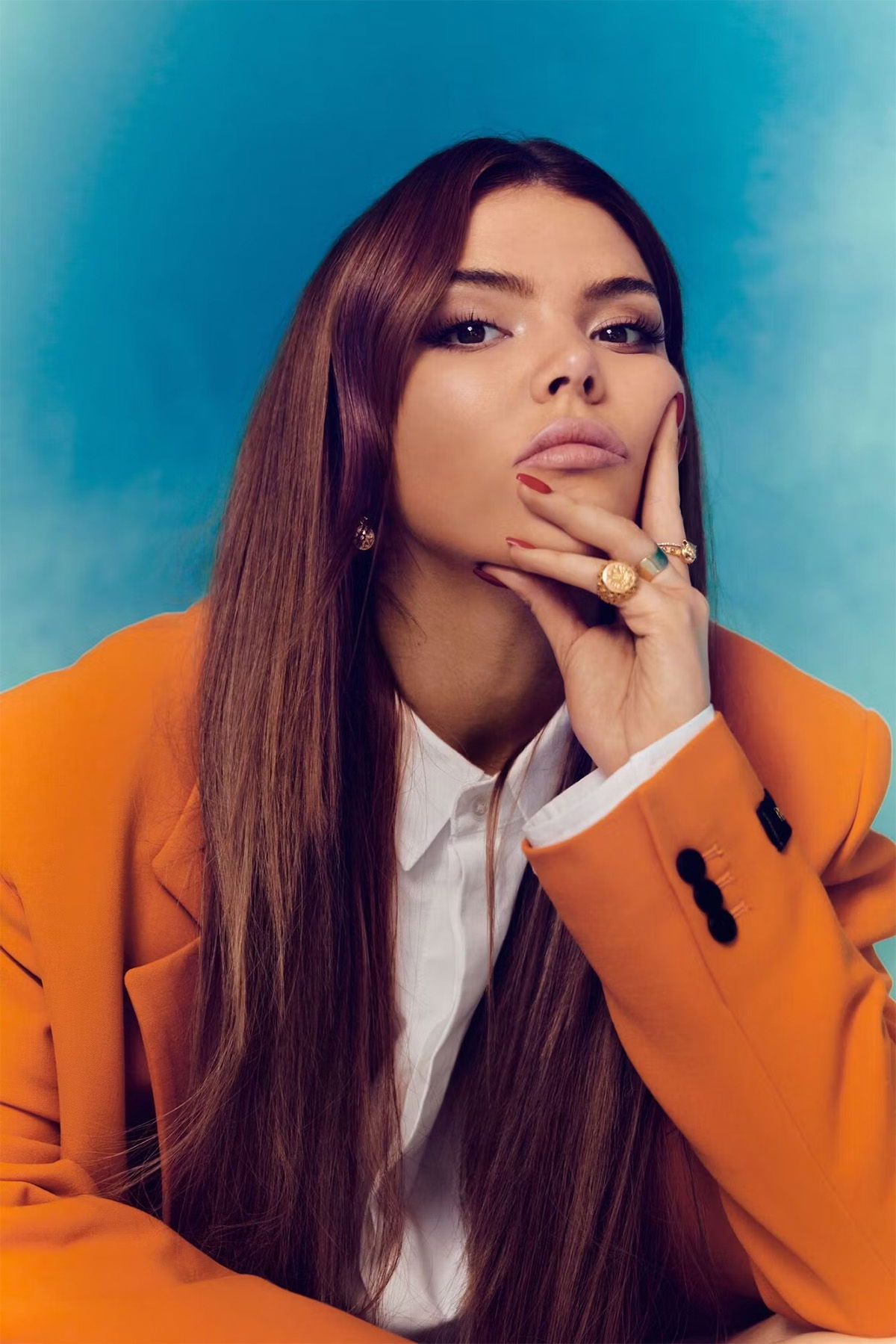
(Photo credit: Alex G. Harper)
SH: You mentioned your sound. Do you think you’ve found your true sound, the thing you want to stick with, or is it something that’s constantly evolving?
Bu: I think both. I think I did find my sound, and Drop By When You Drop Dead is the prequel for that. It’s like the baby version and the more developed one is coming.
SH: What are you most excited about with your upcoming projects?
Bu: I want to release music so, so bad! I’m really excited to produce and also write for other artists at some point. Definitely perform more. That’d be really fun.
SH: Coming from a well-known family name, how do you navigate building a distinct artist identity so that the focus stays on your music?
Bu: I hope to be able to do what I love, and I can’t really control the outside. I grew up with an immense, constant education of the arts and that was just normal in my household. It’s something that I’ve really normalized in my life. When I envision myself having kids one day, I’m like they’ll have to watch all these films, listen to this music and understand a bunch of things I grew up with. Now I understand not to take that for granted. It’s honestly really special to me, and I just know I’m going to carry it for my life and hopefully bring it into the future.
SH: Fashion is such a big part of your identity. How do your style and music work together as parts of your overall creative expression?
Bu: I feel like with colors. Last year, I was really into blue and everything I wear and sing has to be the same color in my head.
SH: Is there anything else you would like to add?
Bu: There’s a quote I like. I’ve been reading about Tao and, I wrote something while reading the other day. I wrote, “Courage is not going forward, but refusing to move until moving is authentic.”
Looking to learn more about rising Latin artists? Click HERE to read our interview with GALE.